What Is a Financial Buffer?
A financial buffer, also known as an emergency fund, is money you keep separate for necessary and unexpected expenses. Think of:
- Repairing or replacing household appliances
- Unexpected maintenance on your car or home
- A higher health insurance deductible or other healthcare costs
- Temporary loss of income
- A necessary journey or other emergency
A buffer is not intended for holidays, gifts, or annual taxes. You can see those expenses coming and are better off including them in separate savings goals or sinking funds.
How Much of a Buffer Do You Need?
A practical way to calculate your financial buffer is: Monthly essential expenses × desired number of months + expected replacement costs
Your essential expenses are the costs that continue when your income temporarily decreases. Think of housing, energy, groceries, insurance, transport, and minimum debt repayments.
The number of months you want to be able to cover depends on your situation. Someone with a permanent employment contract and two incomes within the household may be able to manage with a smaller income buffer. A freelancer with variable income will often want more security.
Example of an Emergency Fund Calculator
Suppose your essential expenses are €1,700 per month. You want to be able to cover three months and expect that several important appliances will need replacing within a few years.
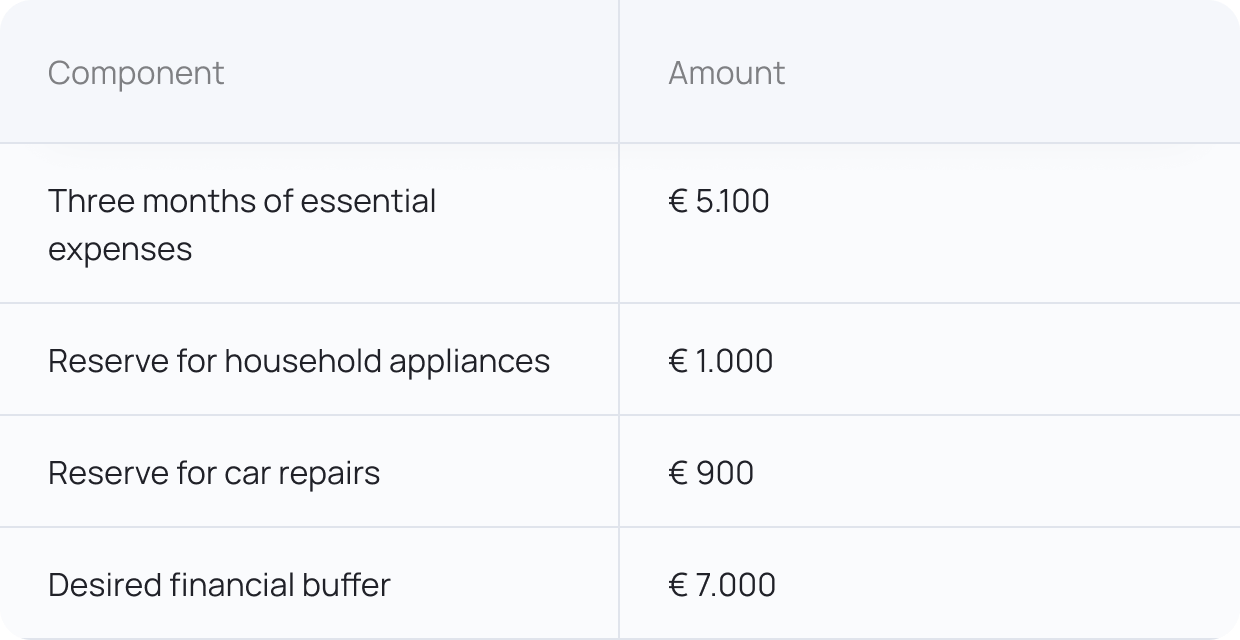
The calculation is: (€1,700 × 3) + €1,900 = €7,000
This is not a mandatory minimum but a personal target amount. You can adjust it when your family situation, income, or fixed expenses change.
Which Factors Determine Your Buffer?
Your type of home 🏡
If you own a home, you are responsible for maintenance and repairs yourself. Think of a leak, a broken central-heating boiler, or roof problems. A tenant has to pay for less home maintenance personally, but may still need money for furniture and appliances.
Your transport 🚘
A car can cause unexpected costs, such as repairs, a new battery, or tyres. If you mainly travel by public transport or bicycle, you will generally need a smaller transport reserve.
Your family situation 👨👩👦👦
Unexpected costs can increase more quickly when you have children. Think of healthcare, clothing, school supplies, or replacing a bicycle or laptop.
Your income 💰
With a fixed and predictable income, the risk of sudden fluctuations is lower. Entrepreneurs, freelancers, and flexible workers are often wise to reserve several months of essential expenses. However, keep business buffers and your personal emergency fund separate.
How to Build Your Emergency Fund
If your desired buffer is €6,000 and you've already saved €1,500, then you still need €4,500. If you want to build that amount within eighteen months, you need to set aside: €4,500 ÷ 18 = €250 per month
Is that not achievable? Extend the period or start with an initial milestone, such as €1,000. This gives you a basic buffer for smaller setbacks more quickly. Only use your buffer for necessary, unexpected costs. Replenish it afterwards.
Set Your Buffer as a Savings Goal
Your financial buffer does not have to equal the average amount of savings held by someone your age. The amount should suit your fixed expenses, possessions, family, and income security. First, calculate your essential monthly expenses and add possible replacement costs. Then set a savings goal in Grassfeld with the desired amount and a realistic deadline. By linking your bank account and tracking your progress, you can see how much you can set aside each month.